














































 As wildfires continue to pose significant threats to communities and ecosystems worldwide, the integration of drones and cutting-edge technologies has emerged as a game-changer in wildfire management efforts. In this article, we’ll delve into the innovative use of fireball-dropping drones and other advanced technologies that are revolutionizing the way wildfires are detected, monitored, and extinguished. By harnessing these capabilities, firefighting agencies and emergency responders are enhancing their ability to combat wildfires more effectively and mitigate their devastating impact.
Utilizing Fireball-Dropping Drones in Wildfire Suppression: One of the most exciting advancements in wildfire management is the deployment of fireball-dropping drones, also known as pyro-drones. These specialized drones are equipped with payloads of chemical balls that ignite upon impact, enabling them to start controlled fires or backburns to contain and suppress wildfires. By strategically deploying pyro-drones, firefighters can create firebreaks, eliminate fuel sources, and manipulate fire behavior to protect communities and natural resources. This innovative approach to wildfire suppression offers a safer and more efficient alternative to traditional firefighting methods, particularly in remote or inaccessible areas.
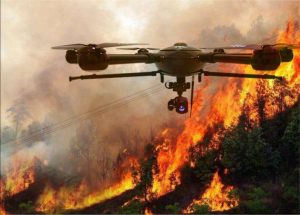 Enhancing Wildfire Detection and Monitoring with Drone Technology: In addition to firefighting capabilities, drones are invaluable tools for wildfire detection and monitoring. Equipped with high-resolution cameras, thermal imaging sensors, and multispectral cameras, drones can rapidly survey vast areas of terrain, identify hotspot activity, and assess fire behavior in real time. This aerial reconnaissance provides firefighters and incident commanders with critical situational awareness, enabling them to make informed decisions and deploy resources more effectively. Furthermore, drones can be deployed in hazardous or inaccessible environments where manned aircraft or ground crews cannot operate safely, enhancing overall response capabilities.
Integration of AI and Data Analytics for Predictive Wildfire Modeling: Advancements in artificial intelligence (AI) and data analytics are further revolutionizing wildfire management by enabling predictive modeling and early warning systems. By analyzing historical data, weather patterns, terrain features, and other variables, AI algorithms can forecast wildfire behavior, identify high-risk areas, and anticipate potential ignition sources. This proactive approach allows firefighting agencies to allocate resources preemptively, implement preventative measures, and mobilize response efforts before wildfires escalate. The integration of AI-driven predictive modeling with drone technology enhances the effectiveness of wildfire management strategies and improves overall wildfire preparedness and response capabilities.
Conclusion: The integration of drones and innovative technologies is transforming wildfire management practices, empowering firefighters and emergency responders to address wildfires with greater precision, efficiency, and effectiveness. From the deployment of fireball-dropping drones for targeted suppression to the use of AI-driven predictive modeling for proactive planning, these advancements are revolutionizing the way wildfires are detected, monitored, and extinguished.
As wildfire seasons become increasingly severe and unpredictable, the continued development and adoption of drone technology and innovative solutions are essential for enhancing public safety, protecting communities, and preserving natural landscapes for future generations.