














































 In today’s increasingly complex security environment, enterprises across industrial, commercial, governmental, and critical-infrastructure sectors are accelerating their transition toward drone-enabled aerial surveillance as an indispensable extension of their protection architecture. This shift is not emerging from novelty or experimentation but from a strategic response to structural deficiencies in traditional ground-based security systems and the expanding scale and sophistication of modern threats.
Organisations operating in high-risk domains—whether managing vast industrial facilities, dispersed logistic corridors, energy sites, ports, data centres, public venues, or metropolitan districts—are facing a convergence of pressures: rising operational costs, intensifying regulatory scrutiny, labour constraints, elevated physical-security expectations, and an adversarial landscape that continues to evolve in unpredictability and asymmetry.
Against this backdrop, aerial security has moved from a future-leaning concept to a core operational asset, offering a mobility-centric, sensor-rich, and data-driven capability set that significantly outperforms conventional approaches. As a result, drone technologies have become one of the most impactful force multipliers available to security leaders seeking to modernise their surveillance strategies, optimise resource utilisation, and elevate situational awareness to unprecedented levels.
The limitations of legacy security models are at the centre of this industry-wide transformation. Static CCTV systems, while essential, suffer from permanent field-of-view constraints, infrastructure-dependent placement, susceptibility to obstructions, and an inability to adapt to dynamic incidents. Ground patrols—whether personnel-based or vehicle-driven—are inherently constrained by line-of-sight, physical accessibility, and the human limitations of endurance, reaction time, and risk exposure.
Even advanced sensor networks, such as perimeter-intrusion detection systems or thermal boundary monitors, remain heavily dependent on fixed infrastructure layouts and often generate false positives that require on-site confirmation. As organisations continue to expand geographically or operate across uneven terrain—large warehouses, solar farms, refineries, pipelines, distribution centres, or remote mining facilities—the cost and complexity of scaling ground-based security systems grow exponentially.
Moreover, global shortages in qualified security labour have intensified the need for augmentative automation to support overstretched teams, particularly in high-demand environments where 24/7 vigilance is non-negotiable. In essence, the traditional security framework is reaching a point of diminishing returns, prompting leaders to seek adaptable, intelligent, and high-coverage solutions that align with modern operational realities.
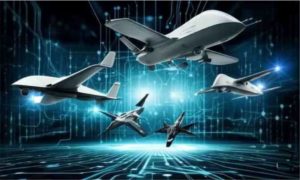 Drone-based aerial security directly addresses these structural constraints by providing mobility, real-time responsiveness, and autonomous intelligence that fixed systems cannot match. Modern drones equipped with optical zoom, thermal imaging, onboard processing, and secure wireless communication deliver continuous visibility over large or obstructed areas with unparalleled responsiveness. Instead of waiting for human patrol units to verify an alarm, drone fleets can automatically deploy to a triggered location, stream live high-resolution video to control centres, and use AI-based analytics to classify detected objects, track movement patterns, and differentiate between human activity, vehicles, animals, or environmental anomalies.
This automation materially reduces response times, enhances threat validation accuracy, and minimises unnecessary human dispatches. Many enterprise-grade systems now integrate autonomous docking stations that enable drones to charge, deploy, and land without human intervention, allowing for truly continuous aerial patrol operations. Combined with cloud-based management platforms, these drones create a persistent, scalable, and cost-efficient security layer that operates across weather windows, day-night cycles, and complex environmental conditions.
The integration of advanced analytics and automation is a major catalyst accelerating enterprise adoption. Next-generation aerial security platforms incorporate AI-driven functions such as predictive surveillance, behavioural anomaly detection, automated perimeter routing, geofencing, and heat-signature monitoring. These capabilities transform drones from simple visual observation tools into intelligent airborne sensors capable of providing security teams with actionable insights in real time.
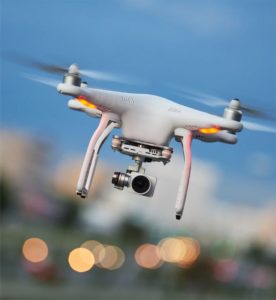 For example, AI-based perimeter analytics allow a drone to autonomously scan fence lines, detect anomalies such as breaching attempts or environmental damage, and immediately relay findings for assessment. Machine-learning models trained on past incidents can identify recurring patterns or emerging threats, enabling predictive maintenance and proactive security adjustments. The integration of multi-sensor fusion—combining visible light, infrared, radar, and sometimes LiDAR—enhances accuracy across weather conditions and transforms drones into robust detection assets. This analytical backbone elevates aerial security from reactive monitoring to a proactive, intelligence-led surveillance model that better aligns with enterprise risk-management strategies.
Operational cost efficiency also plays a central role in the shift toward drone-enabled protection strategies. Traditional expansion of security capacity typically requires increased staffing, additional fixed infrastructure, and significant maintenance expenditure. Drones, by contrast, provide an elastic, scalable alternative that reduces dependence on labour-intensive patrols and costly physical installations. A single drone can cover several kilometres in minutes, replacing or augmenting multiple ground patrols and enabling centralised monitoring from a remote command environment.
Over time, the cost of maintaining autonomous aerial fleets is significantly lower than maintaining a constantly expanding workforce or deploying fixed sensors across vast or inaccessible areas. For organisations managing geographically dispersed sites or multiple locations, drone fleets also enable centralised oversight—allowing security teams to manage operations remotely, standardise procedures, and improve coordination across regions without duplicating resources. This distributed yet centralised model yields impressive operational efficiency, particularly for organisations pursuing digital transformation or consolidating security operations through enterprise command centres.
Beyond operational efficiency, drone-based aerial security materially enhances the safety and resilience of the workforce. Security personnel operating in high-risk zones—such as chemical facilities, power stations, ports, or remote industrial terrains—face exposure to hazardous environments, adversarial conditions, and unpredictable incidents. Drones enable teams to assess situations from a safe distance, reducing direct exposure while still enabling rapid response coordination. For example, drones can support emergency scenarios such as fire outbreaks, hazardous material spills, or environmental disasters by providing thermal imagery, real-time situational mapping, and live video feeds to emergency responders.
By offering a safe aerial perspective, drones minimise the need for personnel to enter dangerous areas without prior intelligence. This significantly improves safety outcomes and reduces liability exposure for organisations operating in regulated or high-risk industries. Additionally, drones support resilience planning by providing aerial documentation of infrastructure, conducting post-event assessments, and enabling rapid operational continuity checks, making them invaluable during recovery cycles after natural disasters or operational disruptions.
Another driving factor behind the adoption of aerial security is the strategic compatibility of drone systems with modern digital security ecosystems. As enterprises increasingly transition toward integrated security platforms that unify video surveillance, access control, cyber monitoring, IoT sensors, and alarm systems into a single operational environment, drones naturally extend these capabilities.
Through API-driven integrations and cloud-based architectures, drones can be linked to alarm triggers, access-control events, perimeter breaches, or environmental sensors, enabling automated drone dispatch based on predefined conditions. This interoperability embeds drones directly into the security technology stack, transforming them from isolated tools into fully orchestrated components within an enterprise’s overarching security operations framework. Many organisations leverage this integration to build remote operation centres where drone feeds, AI analytics, and ground-sensor data converge to give operators a comprehensive operational picture. This degree of integration aligns strongly with long-term digital transformation goals and supports a future-ready security model where automation, analytics, and mobility reinforce the organisation’s ability to detect, deter, and respond to threats.
Regulatory evolution is also contributing to the acceleration of drone adoption. Many regions are introducing clearer frameworks for operations beyond visual line of sight (BVLOS), remote identification, and automated flight permissions. As these regulations mature, enterprises can deploy drones more freely across wider areas and in more complex environments.