


















































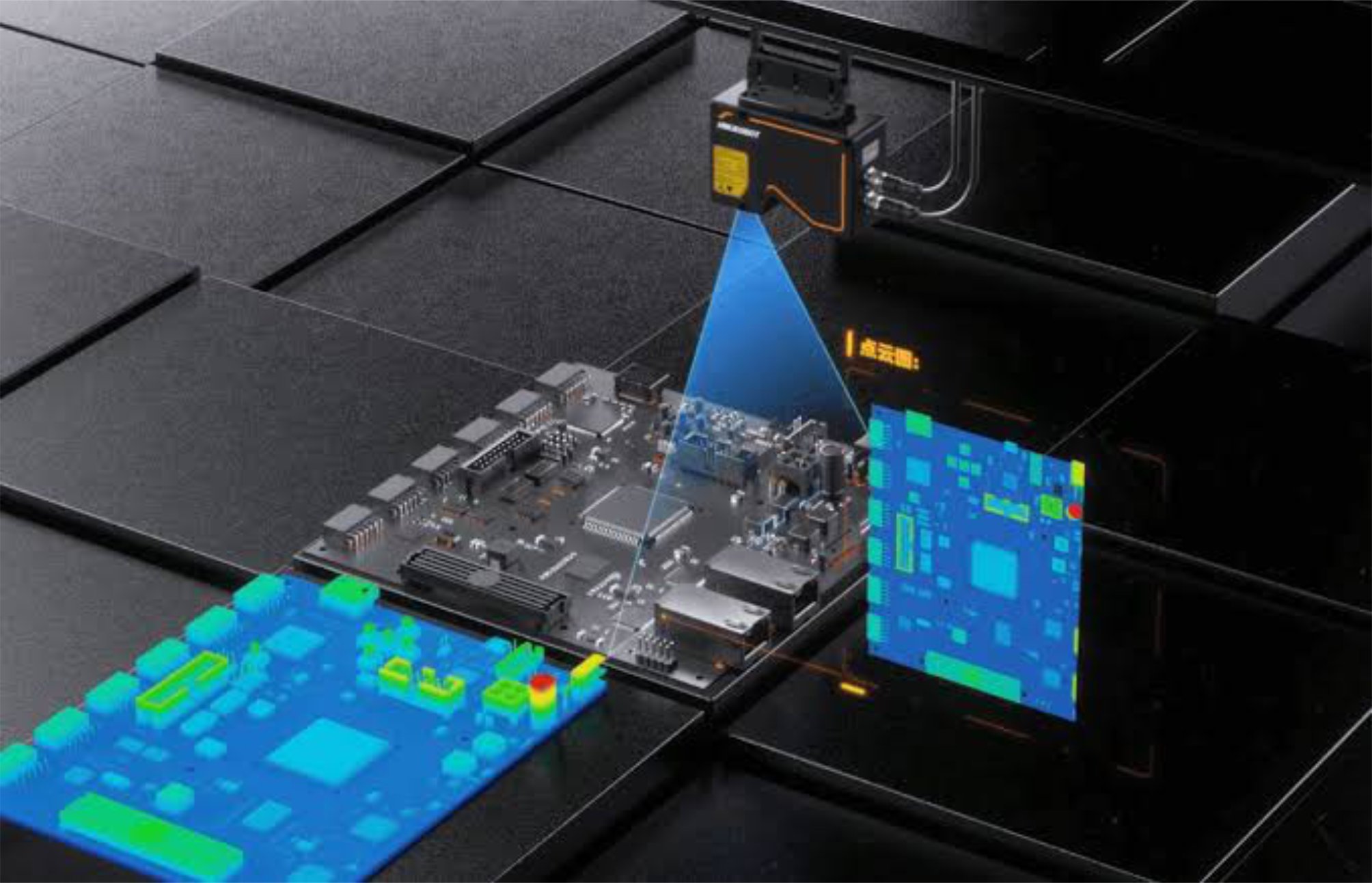
 The future roadmap for the Hikrobot DP Series 3D Laser Profilers focuses on pushing beyond the limits of standard laser triangulation by combining ultra-high physical resolution with deeper on-device automation. As smart manufacturing demands faster, sub-micron quality control in sectors like EV lithium batteries and advanced electronics, next-generation trends are shifting from pure hardware metrics to intelligent, adaptive edge-sensing systems.
The primary future trends driving this real-time micrometre-level ecosystem include:
Embedded “Edge Learning” & Autonomous Self-Training
- Zero-Code AI Inspections: Hikrobot is actively merging its specialised Edge Learning Algorithms-currently prominent in its smart camera lines-directly into the 3D profiling firmware.
- Self-Training on the Sensor: Instead of sending raw point clouds to a heavy industrial server for defect mapping, future firmware iterations will let the profiler train AI models using as few as 1 to 5 sample images directly on the unit, automating the detection of micro-tears or dents natively.
Multi-Wavelength Light Sources for Complex Materials
- Beyond 405nm Blue Lasers: While ultra-uniform fine blue light remains the standard for blocking reflections on metallic or oily surfaces, Hikrobot is diversifying its portfolio with alternative laser wavelengths (such as red or specialised custom laser spectrums).
- Dynamic Material Adaptation: This lets a single factory line switch between highly specular (shiny electronic contacts) and highly absorbing (matte black carbon or automotive rubber seals) materials without sacrificing sub-pixel line-extraction accuracy.
Sub-Micron Z-Axis Precision & Larger Sensor Arrays
- Escalating Sensor Matrices: Building on the 2000×2000 sensor arrays in the high-end DP4000 series, the roadmap targets even tighter sub-micron vertical resolution.
- Telecentric Optics Optimisation: Future hardware updates rely heavily on advanced telecentric optical paths to keep light sensitivity extremely high across wide dynamic ranges, allowing Z-axis precision to drop well below the current 6.47 μm threshold.
Seamless High-Frequency GigE Vision Streaming
- 49 kHz+ Synchronisation: To match the throughput of automated smart factories, data transmission channels are scaling up.
- Centralised Software Synthesis: Using the updated Hikrobot Machine Vision Software (MVS), future pipelines will allow real-time synchronisation and automatic stitching of multi-camera arrays without adding latency to the physical production line.
Native Multi-Profiler Collaborative Hardware
- Occlusion-Free Binocular Arrays: Building on single-line binocular architectures, future setups feature plug-and-play synchronisation, with multiple distinct profilers operating in a unified mesh layout.
- Automated Spatial Calibration: New algorithmic blocks allow automated system self-calibration, letting robots instantly map out complex 3D shapes from a master point cloud with zero manual point-to-point programming. The Hikrobot 3D Laser Profiler (DP Series) is a high-precision, non-contact measurement sensor that uses laser triangulation technology to generate micrometre-level 3D point clouds, depth images, and profiles in real time. These industrial sensors feature integrated edge computing, enabling processing speeds up to 49 kHz without consuming host CPU resources. They are widely adopted worldwide, including in key manufacturing ecosystems in India, for electronic components, EV lithium batteries, automotive manufacturing, and PCB inspection.
Hikrobot organises its profile sensors into targeted performance tiers:
- DP2000 Series: The standard workhorse tier offering 3,200 profile points, a scan rate up to 23.9 kHz, and IP67 protection. Models like the MV-DP2240-01P feature Z-axis resolution down to 6.47 μm.
- DP3000 Series: A high-precision line boosting scan rates up to 46.7 kHz with enhanced light sensitivity, 95% laser uniformity, and ultra-low noise.
- DP4000 Series: The flagship tier featuring a large 2000×2000 sensor array, up to 4,000 pixels per line, telecentric optical design, and scan speeds up to 49 kHz.
- Binocular Single-Line Series: Uses twin cameras paired with a single laser projector to capture blind spots and complex geometry without shaded occlusions.
Key Technical Innovations
- Sub-Pixel Centre Extraction: Hardware-level algorithms track the laser line reflection down to an accuracy of 0.05 pixels.
- Stray Light Halo Filtering: Eliminates optical noise and reflections when scanning mirror-like, metallic, or wet surfaces.
- Single-Frame HDR: Combines diverse exposure parameters on a single pass to map parts featuring both highly reflective and deep matte-black materials.
- Multi-Camera Stitching: Supports collaborative setups where multiple sensors merge individual profile views into a unified 3D point cloud for large objects.
- Built-in Post-Processing: Hard-coded spatial filtering, time-domain filtering, and empty point interpolation run natively on the device.
Application Scenarios
- Lithium Battery Production: Inspection of blue film battery surfaces for air bubbles, droplets, and soft pack battery dent detection.
- Consumer Electronics: Precise Z-axis height checks, coplanarity testing, and gap/flush measurements on assembly lines.
- Automotive Parts: Checking black rubber seals, welding seams, safety belt weaves, and metallic casings for micro-scratches.
Key Advantages
The core advantages of using the Hikrobot DP Series 3D Laser Profilers stem directly from their ability to process massive amounts of spatial data instantly at the physical edge. By handling micrometre-level inspections natively, these sensors eliminate traditional data bottlenecks on high-speed factory lines.
The primary operational and technical advantages include:
High-Speed Processing via Edge Computing
- Zero Host CPU Drain: All heavy algorithmic math required for sub-pixel extraction, 3D point cloud construction, and profile rendering runs on the sensor’s internal SoC. The factory PC only receives ready-to-use data.
- Ultra-Fast Throughput: With scanning frequencies scaling up to 49 kHz, the sensors inspect rapidly moving components in real time without forcing production lines to slow down.
Extreme Metrology Precision
- Micrometre-Level Accuracy: Z-axis resolution down to 6.47 μm ensures that microscopic surface defects, minuscule warpages, and structural unevenness are detected instantly.
- Blue Laser Uniformity: The 405nm uniform blue laser line significantly reduces optical distortion and scattering, providing clean profile slices even on tricky surface textures.
Resilience against Optical Noise
- Single-Frame HDR: Easily scans target objects composed of wildly different materials, such as a glossy metal contact sitting directly next to a dark, matte plastic housing, in a single pass.
- Halo & Stray Light Filtering: Built-in firmware dynamically removes secondary reflections, glare, or light scatter caused by oily surfaces, wet coatings, or highly reflective mirror-like metallic parts.
Smart System Integration
- Plug-and-Play Stitching: Multiple profilers can be natively linked and calibrated within the Hikrobot Machine Vision Software (MVS) to create full 360-degree or extra-wide 3D views without complex external custom code.
- Standardised Protocols: Built on open GigE Vision and GenICam standards, making it straightforward to feed real-time depth maps and point clouds directly into standard robotic automation architectures.
For more information, please visit us at www.hikvisionindia.com