


















































Material Composition of Ball Valves – By Sanjay Jude
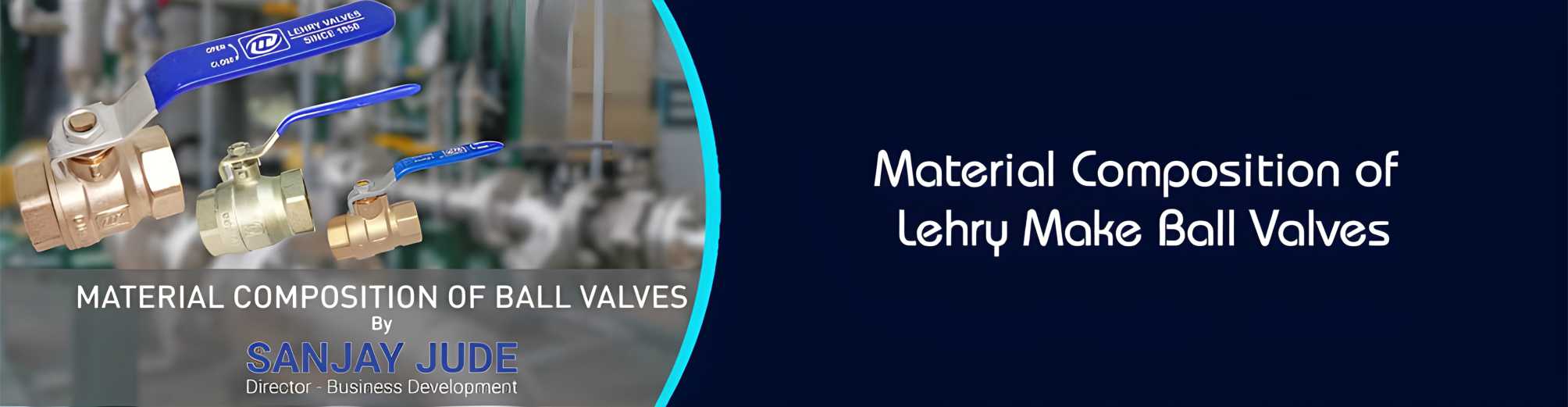
 Valves are essentially devices installed on a pipeline to control or isolate the flow. They can be kept in fully shut, open, or partially open mode. In plumbing systems, the valves that are commonly used are Gate, Ball, Globe valves.
In the field of plumbing, we have numerous standards that guide us on the valve and material selection. However, we miss out on two major parameters:
- Contents of the valve’s body that is NOT in “contact” with water
- Testing standards that actually MATTER.
 Let us begin with point one. In India, we mostly follow the CW617N standard for brass alloy used for ball valves used for plumbing. This is a standard that sets limits on the percentage of the different metals used in the brass alloy. Lead is used in brass alloys meant for forging as the lead makes the alloy ductile enough for forging. The Standard states that the amount of lead (Pb) is not to be more than 2.5% and Copper (Cu) not more than 60% etc. This again is “limited” to the alloy used for the valve’s body that comes in contact with water. Other components use alloys other than CW 617N.
A major problem faced in a ball valve is NOT the body because this is the sturdiest “part” and nothing hardly ever goes wrong with it but what DOES go wrong – is with the HANDLE.
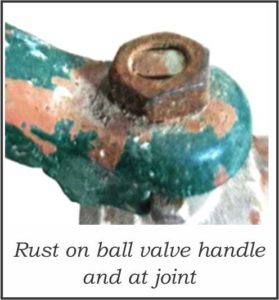
Why? It is a rather “rusty” issue, really! The handle is fixed on the valve by a nut, and this “set up” forms a crevice. Now, rusting is accelerated at this localized region and thus makes this assembly weak.
It is due to this that we see, mostly in coastal regions, that many handles of ball valves break within a span of one year. This problem gets extra attention when the final site inspection is carried out by the consultant and the client. The consultant will ask for the replacement of the ball valve if any ball valve has either rust or a rusted handle. The ball valve is actually in perfect working condition – but the consultant will ask for a replacement with a rust-free new ball valve. The contractor knows that without the replacement his final payment will get stuck. This problem is further aggravated if the project has been delayed for various reasons. It could be as much as 18 – 36 months between valve installation and final inspection.
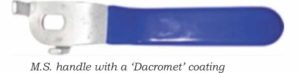
The solution – Dacromet*. It is always best to use brass ball valves that have Dacromet plating on their handles. Dacromet is a mix of aluminum and zinc flakes and acts as a “barrier” to corrosion and making it three times stronger than zinc-coated handles. Dacromet is widely used in the automobile industry for the very same reason – corrosion prevention!
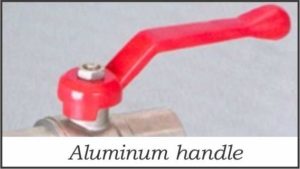
 An alternative solution is to use aluminum handles. These handles are completely rust-proof and long-lasting. There is a drawback of aluminum handles – they are brittle and liable to crack in case of impact (e.g. when the valve is dropped onto the floor).
 Testing – We see embossed on ball valves “PN40” / “PN30” / “PN25” / “PN16” – meaning that the seats of the brass ball valves are tested to these pressures (in bar or kg/cm2 – e.g., PN16 valves are tested to 16 bar). These are the required pressure testing standards BUT here again, in the field of plumbing, we hardly ever operate at such high pressures.
On this subject, we need to study a little beyond the body of the valve – we look at the ball itself! The ball is a free-floating ball that “sits” on the soft seat of the valve. When the valve is operated at high pressure, it is natural that the ball will sit on the seat due to the pressure, and chances of leakage are second to none. However, at lower pressures, there is no absolute “guarantee” that this free-floating ball would sit securely on the soft seat. Something like a small dent on the seat could cause leakage that would not otherwise be seen in high-pressure tests. This would obviously cause leakage and these low pressures are what we face and implement in plumbing.
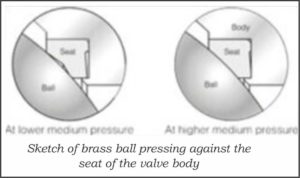 This is why it is absolutely necessary to have ball valves tested at even low pressures (usually through pneumatic bubble test) so the buyer can be certain that the valve would not leak at even low operating pressures. On a concluding note – there is a standard available for all components and a solution to potential technical problems.