






















































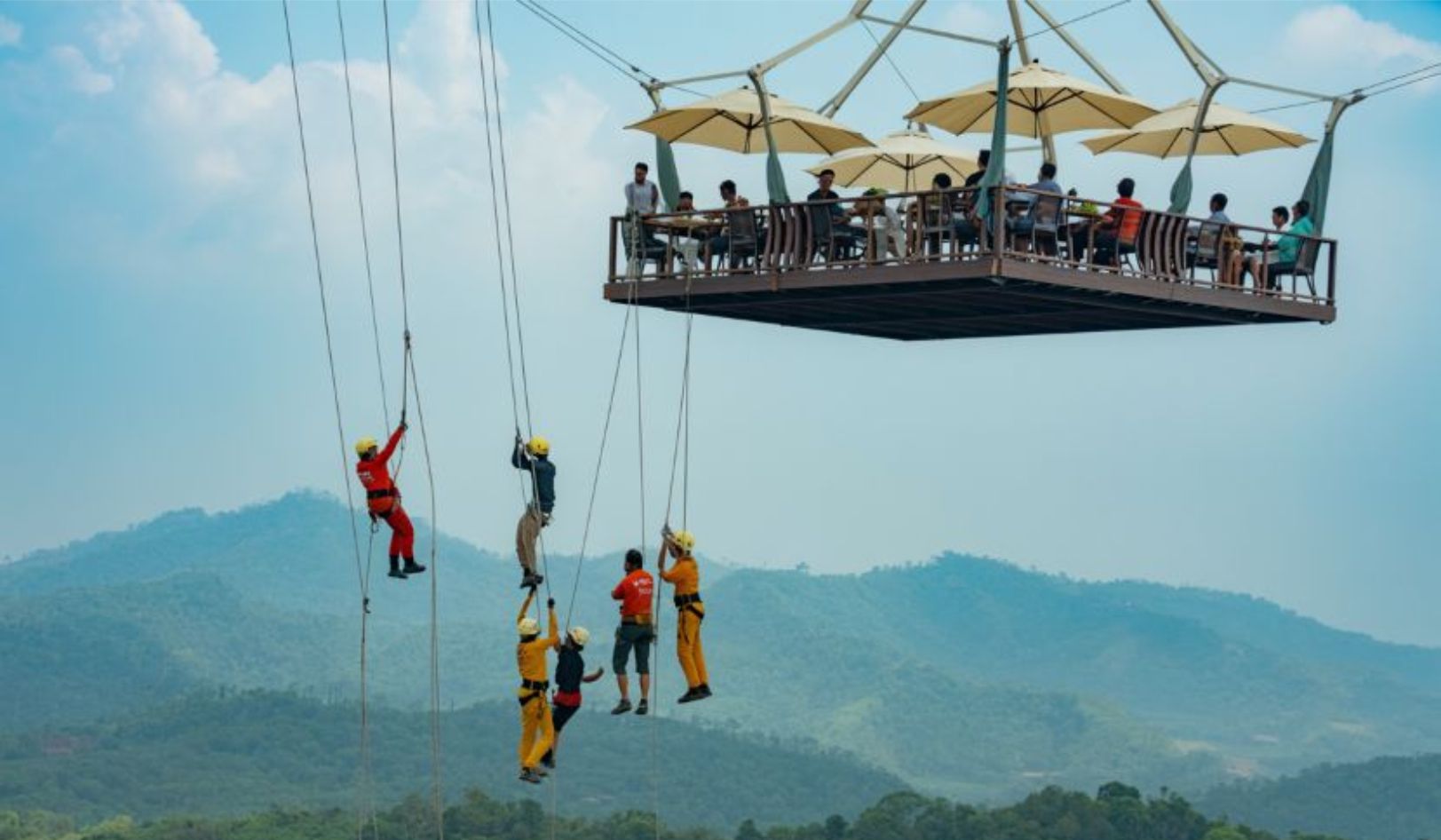
 What was meant to be an unforgettable aerial dining experience in the tranquil hills of Anachal turned into a full-fledged emergency when a crane failure left a group of tourists stranded 120 feet above ground. Suspended mid-air for nearly 90 minutes, the incident swiftly escalated into a situation demanding advanced tactical intervention, structural risk assessment, and professional crisis navigation. Yet, within this tense episode emerged a remarkable demonstration of courage and technical precision by Kerala’s elite firefighting and rescue personnel—a team whose swift, coordinated response prevented what could have become a major tragedy.
The sky-dining setup, located in one of the most scenic pockets of Idukki, is designed to elevate guests for an immersive cliffside dining experience. On this day, however, a sudden malfunction in the crane’s rotation system halted the platform mid-operation. The structure, which relies on hydraulic and mechanical synchronization, locked into an immobile position. With the platform dangling high above the valley floor, the initial sense of thrill among visitors quickly gave way to fear. Several guests began experiencing dizziness, anxiety, and distress as the minutes stretched into an extended period of uncertainty.
Emergency teams were alerted immediately, activating a multilevel response mechanism from the region’s firefighting and disaster management units. Within minutes, a professionally trained rescue squad arrived on-site, launching what would soon be recognized as one of the most methodical high-altitude rescue efforts in recent local history.
A Detailed Breakdown of the Rescue Efforts
The rescue operation began with an immediate perimeter assessment. Firefighters examined the crane’s structural integrity, stability under load, and potential stress points triggered by the malfunction. This initial diagnostic was essential, as attempting a rescue without evaluating load distribution could have jeopardized both the victims and responders.
With confirmation that the crane frame remained structurally stable, the rescue team initiated Phase One of their operation: ascent and access. Equipped with harnesses, carabiners, shock absorbers, anchor belts, and industrial-grade rope systems, a select group of climbers began their vertical ascent along the crane’s lattice structure. The climb itself was a high-risk maneuver, requiring calculated movements and professional rope-handling techniques to counteract wind sways and platform oscillation.
Upon reaching the suspended platform, responders shifted to Phase Two: securing the victims. The team prioritized psychological stabilization—speaking to the stranded tourists, reassuring them, and evaluating individual levels of distress. Panic management in vertical rescue operations is crucial, as sudden movements or unrestrained actions by the stranded could destabilize the platform.
Each individual was fitted with a full-body rescue harness and tethered to independent safety lines. This meticulous process was executed slowly and systematically to prevent tipping forces or destabilizing the platform. Rescuers employed controlled descent techniques, using double-locking descenders and friction devices to guide each tourist down the crane safely. The descent route itself was pre-evaluated moments earlier to ensure that climbers could navigate without rope entanglement or impact with crane components.
Parallel to the vertical operation, a ground team continuously monitored wind speeds, rope tension, and overall structural behavior through constant radio communication. This dual-level coordination ensured that both the climbers and the stranded passengers remained within controlled safety parameters throughout the descent.
Phase Three involved extraction and post-rescue stabilization. Once each tourist reached the ground, medical officers conducted quick health checks. Though shaken, no one suffered any physical injuries—an outcome made possible entirely due to the flawless execution of the rescue plan. The operation, from the first responder’s ascent to the final descent, reflected unmatched discipline and high-altitude rescue proficiency.
The Broader Implications of the Incident
For adventure tourism operators, especially those leveraging mechanical or aerial assets, this incident underscores the irreplaceable importance of stringent maintenance protocols. Sky-dining modules depend heavily on hydraulic precision, load calibration, routinely updated safety documentation, and real-time mechanical condition monitoring. Failures such as the one witnessed in Anachal highlight vulnerabilities that must be mitigated through predictive maintenance systems, structural audits, and regulatory compliance.
From a B2B operations perspective, the rescue underscores the value of inter-agency collaboration, readiness frameworks, and emergency scenario planning. Companies operating experiential tourism offerings must integrate structured risk-mitigation playbooks, define escalation paths, and establish cooperative channels with emergency service providers. High-altitude attractions in particular demand safety redundancies, remote monitoring technologies, and rigorous crew training to anticipate mechanical anomalies before they become critical.
For emergency services and public governance bodies, the incident reinforces the importance of investing in advanced rescue training, equipment modernization, and cross-functional emergency drills. The seamless execution of the rescue demonstrates operational maturity—something that requires both investment and continuous skill development. Vertical rescues involve specialized competencies: rope access techniques, suspended-platform extraction, load-sharing calculations, and situational psychology. Without proper training and tools, such operations can easily escalate into dual-fatality scenarios involving both victims and responders.
This event also carries communications and public-relations implications. With footage circulating online—courtesy of @reporterliveofficial—the incident quickly gained nationwide visibility. In such digitally amplified crises, public messaging becomes a critical pillar of response management. Transparent communication from authorities helps reassure communities, maintain confidence in safety systems, and prevent misinformation from derailing public trust.
A Narrative of Strength, Professionalism, and Human Commitment
In the end, what could have been a catastrophic event transformed into an extraordinary display of technical capability and human resilience. The rescue in Kerala demonstrates that behind every successful emergency response lies a synergy of training, leadership, equipment quality, and unwavering commitment.
For the stranded tourists, the moment their feet touched the ground marked the end of a harrowing ordeal. For the rescue personnel, it was the conclusion of a mission executed with near-flawless precision. And for industry stakeholders, it serves as a powerful case study—highlighting the indispensable need for robust safety infrastructures, collaborative crisis frameworks, and continuous readiness in an era where experiential tourism is rapidly expanding.
The Anachal sky-dining rescue will undoubtedly remain etched in public memory. Not as a tale of disaster, but as a moment where operational excellence met human courage—reminding us that even in moments suspended between fear and uncertainty, heroes climb upward.