





















































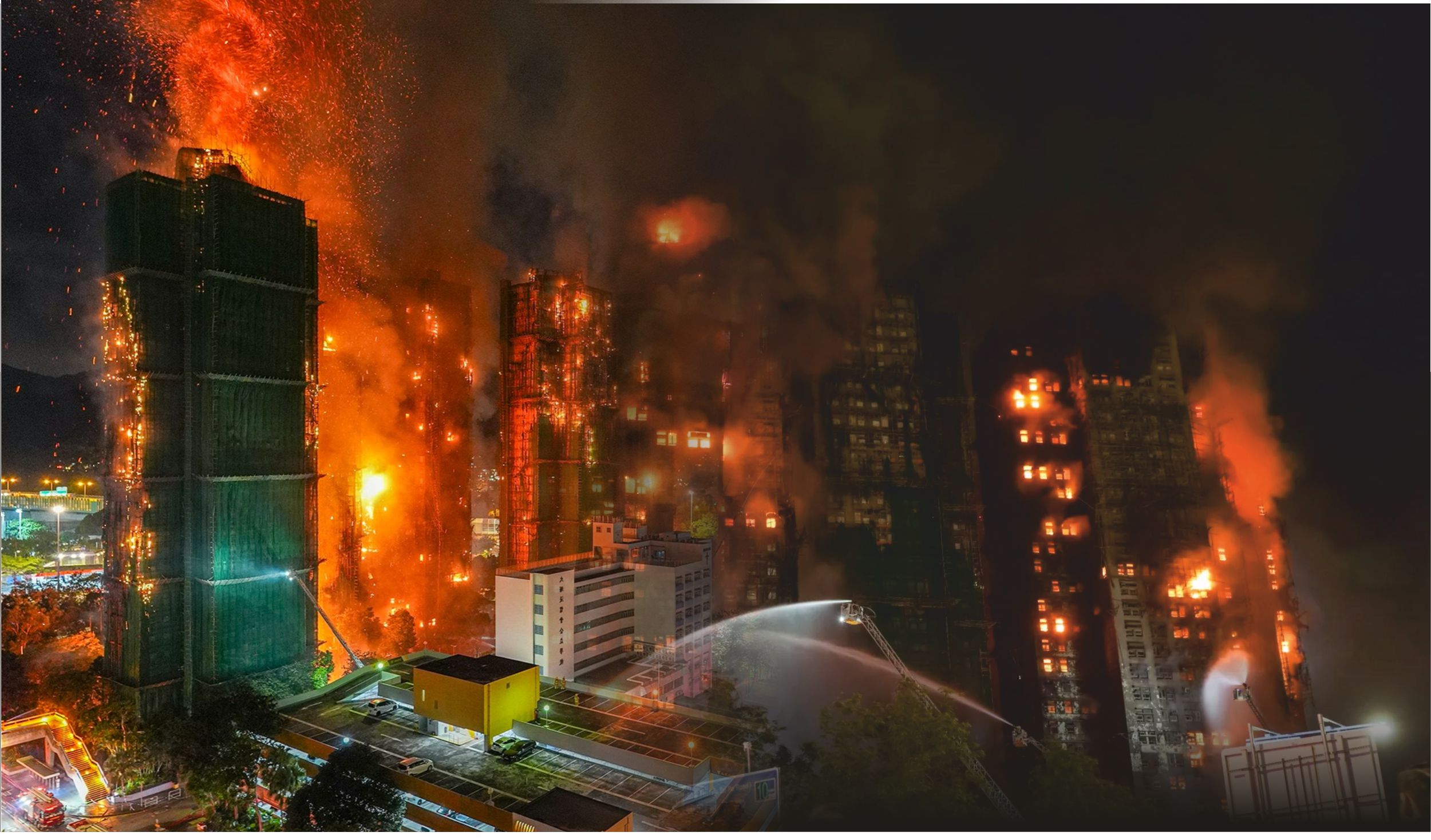
 The firestorm that engulfed a high-rise housing complex in Tai Po has become the most lethal urban blaze Hong Kong has experienced in more than sixty years. With at least 44 confirmed dead, nearly 300 residents unaccounted for, and entire buildings still smoldering well into the following day, this disaster is forcing profound questions about construction oversight, renovation governance, and risk management in densely populated vertical cities.
For business-to-business stakeholders across construction, real-estate operations, building materials supply chains, and public-sector safety regulation, the scale of failure revealed by this fire is a watershed moment. It exposes systemic weaknesses that extend well beyond one estate and calls for a recalibration of both compliance practices and operational standards across the region’s built environment.
This authored analysis dissects the event in detail—its ignition, expansion dynamics, human and operational toll, regulatory implications, and what it signals for the future of construction governance in major Asian metros.
A Cascade of Vulnerabilities: How a Routine Renovation Became a City-Level Tragedy
The blaze erupted mid-afternoon on a Wednesday, originating on a section of bamboo scaffolding wrapped around one of the estate’s towers undergoing renovation. Bamboo scaffolding is an iconic construction method across the city—lightweight, strong, fast to assemble. But it is also extremely combustible. Once ignited, it becomes a vertical fuse.
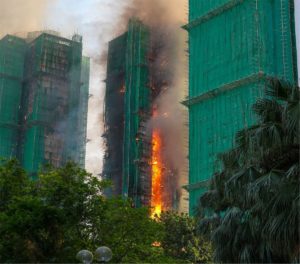 The scaffolding was additionally enveloped in the standard green polymer construction mesh used throughout the region. Investigations now point to large areas of this mesh being non-fire-retardant and, in some locations, improperly installed. When the initial flames took hold, the mesh effectively became an accelerant. Fire raced upward along the exterior façade and leapt horizontally across to adjacent towers that were connected through structural renovation platforms.
Converging factors amplified the fire’s spread:
- A contiguous scaffolding network linked multiple towers, functioning as a pathway for flame transmission across height and distance.
- Polymer mesh and protective wrapping—in several cases apparently non-compliant—ignited rapidly, producing intense radiant heat.
- Unusually dry atmospheric conditions, with the city under high fire-risk alerts since earlier in the week.
- Window coverings made of flammable materials, including polystyrene sheets reportedly used to block dust during interior works.
- Legacy single-pane window designs in the 1980s-era towers, which failed quickly under thermal stress, allowing flames to enter apartments with minimal resistance.
By the time the fire alarm reached level four—just over 40 minutes after ignition—it had already penetrated multiple towers. Within three hours, it escalated to a maximum-severity level five, a rare classification in the city’s emergency system.
Renovation Oversight Under Scrutiny: Early Findings and Arrests
 Even before the fire was fully contained, investigators began focusing on the materials and practices used by the renovation contractor. Police announced the arrest of three senior executives—a pair of company directors and an engineering consultant—on suspicion of gross negligence and manslaughter.
Authorities cited several findings:
- Non-fireproof mesh and protective panels affixed to exterior surfaces.
- Polystyrene and similar flammable materials placed over windows, trapping heat and creating a chimney effect once burning began.
- Unusual debris accumulation across scaffolding platforms, including cardboard and plastic, which may have accelerated fire growth.
- Partial disabling of fire alarms during renovation periods, reported by multiple residents.
- Poor worker practices, including improper disposal of smoking materials, raising questions about site-level governance and enforcement.
While the ultimate ignition source is still under investigation, the volume and type of combustible renovation materials appear to have been decisive in turning a localized construction fire into a full-scale disaster.
Emergency Response: Operational Challenges Inside a Vertical Inferno
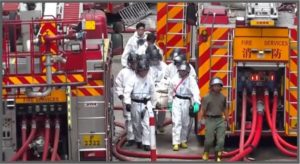
More than 1,200 personnel were deployed to the complex as the fire escalated. Despite immediate mobilization, crews faced severe operational barriers:
Extreme Thermal Conditions
 Temperatures inside several upper-floor apartments remained so high overnight that responders could not physically enter. Even with full gear, heat exposure times were measured in seconds, not minutes.
- Structural Instability
Burning scaffolding collapsed unpredictably. Falling bamboo and metal fittings posed constant risk to crews stationed below and on adjoining towers. Debris showers continued intermittently through the night.
- Smoke Column Entrapment
With multiple towers burning simultaneously, smoke accumulated in vertical channels between the buildings, reducing visibility and increasing toxic exposure.
- Nighttime Hazards
Darkness severely limited aerial assessments and rooftop interventions. Drone footage—circulated by international outlets such as BBC News—showed persistent hotspots and collapse zones far into the morning.
Despite these challenges, firefighters succeeded in bringing four of the towers under control several hours before dawn, though remaining structures continued burning into midday.
Human Impact: Casualties, Displacement, and an Aging Resident Base
 The scale of human loss is devastating. At least 44 fatalities have been confirmed, including one firefighter. Dozens remain in critical or serious condition across the city’s hospitals, while more than 279 residents are still unaccounted for.
The demographic profile of the estate intensified the tragedy: nearly 40 percent of residents are aged 65 or older. Mobility-impaired households were especially vulnerable as lifts ceased functioning and thick smoke spread through stairwells.
By morning, community centers were converted into emergency shelters, hosting close to a thousand displaced residents. Schools near the complex suspended classes, and psychological support teams were deployed to assist students and elderly evacuees.
Families abroad—such as those who periodically return to maintain their apartments—reported frantic attempts to contact loved ones. Group chats and community networks became informal emergency command centers as residents exchanged missing-person lists and evacuation information.
Governance Questions: The Disaster That Residents Feared
A striking narrative has emerged from resident interviews: many felt this scenario was predictable.
Multiple tenants reported:
- Repeated concerns about renovation materials accumulated on exterior platforms.
- Cigarette butts found near window covers installed by construction teams.
- Fire alarms muted because of frequent construction traffic through fire escapes.
- Long-standing warnings in resident groups asking what might happen if a fire broke out.
One resident described the event as “not an accident,” echoing a sentiment shared by many who believe layered neglect—not a single ignition source—was the true cause.
Implications for Construction Governance and B2B Stakeholders
For companies operating in construction, real-estate asset management, building maintenance, and supply-chain logistics across the region, the Tai Po fire will have far-reaching consequences.
- Regulatory Reform Is Imminent
Authorities had already announced earlier this year a phased transition away from bamboo scaffolding in favor of fire-resistant steel alternatives. After this event, acceleration is likely—and mandated compliance audits could become standard.
- Material Certification Will Face Higher Scrutiny
Suppliers of polymer netting, façade protection materials, and window-sealing components should expect:
- Mandatory fire-retardancy certifications
- Randomized onsite inspections
- Severe penalties for non-compliance or mislabeling
Those in manufacturing or distribution should be prepared for rapid policy shifts and increased documentation requirements.
- Renovation Contractors Must Reassess Site Protocols
Practices that previously fell into gray regulatory areas—such as temporary alarm muting, ad hoc debris placement, or informal worker behavior—will likely face stringent enforcement. B2B firms should anticipate:
- Tightened safety governance
- More comprehensive training requirements
- Third-party compliance audits
- Digital logs tracking fire-risk-critical actions
- Owners’ Corporations and Property Managers Will See Expanded Liability
Vertical housing estates, particularly older ones undergoing renovation, will be expected to implement proactive risk-mitigation standards. Insurers may reassess risk models for decades-old tower clusters undergoing simultaneous construction.
- Cross-Border Investors and International Operators Will Re-Examine Exposure
Given the density of high-rise renovations across Asia, multinationals involved in asset ownership or project financing may initiate region-wide reviews of construction safety governance. ESG-oriented investors, in particular, will be sensitive to systemic fire-risk indicators.
The Day After: A City Mourns While Smoke Still Rises
 By morning, heavy smoke still cloaked sections of the estate. Residents returning from temporary shelters walked among fire engines, debris, and charred building exteriors, many searching for missing family members or attempting to assess the state of their homes. International messages of condolence—from the United States and the United Kingdom among others—underscored the
global resonance of the tragedy. Regional leaders expressed grief and pledged support, while the city’s leadership suspended all election campaigning to prioritize rescue and relief operations.
Yet for residents, victims’ families, and frontline responders, the grief is raw and the questions are urgent.
A System Under Strain: Lessons for a Vertical City
The disaster is not merely a single catastrophic event but a reflection of structural vulnerabilities inherent to aging high-rise estates across Asia’s megacities. Renovation cycles in older towers—often involving thousands of residents, interconnected scaffolds, and mixed-material retrofits—present elevated risks that require far stronger oversight than legacy regulatory systems currently provide.
Key systemic lessons emerging from the fire include:
- Exterior renovation configurations can unintentionally create inter-building fire pathways.
- Legacy building envelopes—single-pane windows, outdated fire-rated exteriors—fail rapidly under new construction conditions.
- Combustible polymer-based accessories remain widely used in renovation ecosystems.
- High-rise evacuation procedures for elderly residents require modernization and redundancy planning.
- Construction industry safety standards must integrate environmental risk indicators, including seasonal weather dryness.
The tragedy demonstrates that conventional compliance frameworks are insufficient for today’s high-density vertical environments. Stronger cross-sector collaboration is now imperative: construction firms, regulators, safety engineers, insurers, and property managers must align around a more resilient, forward-looking standard.
Conclusion: Rebuilding Trust, Rebuilding Standards
The Tai Po inferno has exposed the fragility of systems meant to protect residents during routine construction work. As investigations continue and accountability procedures unfold, the tragedy is likely to reshape the region’s regulatory landscape and accelerate reforms many industry voices have long advocated.
For B2B leaders, the event is both a cautionary tale and a call to action. The economic, reputational, and human costs of safety lapses far outweigh the investments required for robust, transparent, and enforced risk management. The vertical city of the future must be designed—and renovated—with a fundamentally new understanding of fire dynamics, material interactions, and occupant vulnerability.
The towers may eventually be rebuilt or repaired. But the lessons of this fire must become permanent architecture within the region’s construction governance. Only then can the trust of residents, investors, and regulators be restored.