


















































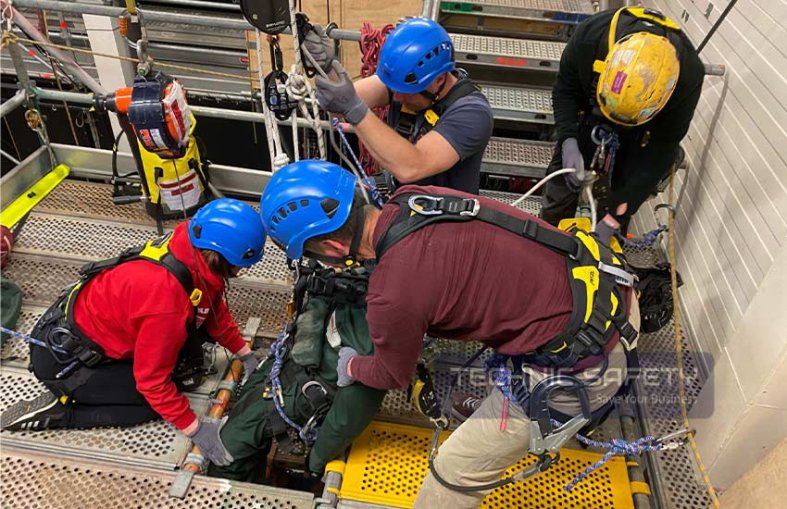
 On the face of it, a vehicle suspended half way up a building is highly unlikely (although I am sure someone can trawl the internet to prove me wrong) but such a training event provides a basis for really thinking outside the box and testing people’s skills, methodology, ability to assess risk and generally places a completely different dynamic on a training session.
When I look at this training scenario I do not simply focus on the likelihood of the supposed event; I do not focus on the fact we have a car halfway up a building, I immediately think:
- Multiple disciplines being utilised (high angle rescue, vehicle extrication and patient care for a start)
- Dynamic risk assessment skills being tested to the limit
- Patient access and their practical relocation; decisions to be made here!
- Assessment of equipment and resources to be used
If I was to plan this as a training event I know that I could discuss options, tactics and considerations with my crew for the best part of a whole day before we even got ready to complete the exercise. It really makes people think, prioritise and (literally) look at things from a different perspective.
“Normal” elements
If you were to look at this for what it is, you would be right in thinking “that will never happen” but let’s look at the component parts of what is going on here, because there are elements of this exercise that are present in many ‘normal’ road rescue scenarios. For example;
- A trapped patient with compromised access meaning extended time before you can reach them
- A vehicle in an unorthodox orientation and as a result a patient in a suboptimal positioThe need to combine multiple rescue skills i.e. technical rescue with line rescue
- The need to choose the correct equipment first time due to the compromised access
These considerations do not just apply to outlandish training sessions like the one created here, but happen at everyday rescues we all attend on a daily basis.
What we have here is a ‘perfect storm’ where anything that could go wrong (and make life difficult for the rescuer) has gone wrong! Next time you see a training scenario like this, do not be too quick to judge.
Whether it was by design or by accident, this example will no doubt raise some key learning outcomes that can be used at more common types of incident.
The Importance of the Rescue Training Cycle
Rescue Training Cycle process
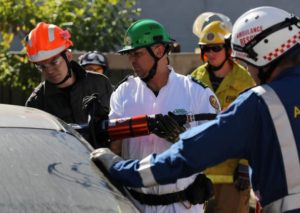 Training should be viewed as a cyclic process for a number of reasons. It should be repeated to update and refresh knowledge and (from a practical point of view) to fight the effects of skills fade which, in my experience, is the single biggest inhibiting factor when it comes to an individual’s ability to safely and efficiently perform complex tasks such as vehicle extrication.
Repetitive training
In learning and development there is a concept known as ‘The Spacing Effect’ which, put simply, means spacing out repetitions of learning points over time; this is generally the way fire and rescue service training is designed and delivered around the world. Research has proved that, if well designed, repetitive training is a very effective way of developing people. This applies to the presentation of learning material (e.g. presentations) and also skills that require motor output (e.g. rescue techniques). Research also suggests that this approach can be counterproductive if the spacing between learning events are not correctly identified.
Not thought out
In my fire and rescue service career the training plan presented to me either by accident or design, (probably the former) reflected this concept, but I would argue that the spacing planned between learning events were not massively thought out and simply reflected ‘how difficult’ we thought things were to grasp and understand; the intervals also (quite rightly) reflected an element of health and safety.
The ideal spacing
So, what is the ideal spacing between learning events? How long should you leave it before taking your crew outside and re training them in a dash relocation. Well, the research also concludes that wider spacings are generally more effective than leaving it a little shorter. So those of you now thinking that ‘doing it every week’ is the way forward, may have to rethink that strategy. It is suggested that the ideal time to revisit a topic is the time it generally takes someone to forget it; the retention level.
Research concludes that wider spacings in your training program are generally more effective than ‘doing it every week’.
Give it some thought
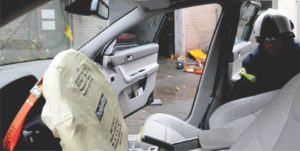 It is impossible to identify the retention level for every skill we know and learn in our careers but what this would suggest to me is that we likely need to give more thought to our training frequencies for certain processes and procedures that we are expected to recall and repeat in our daily work. I know from experience that there are certain training sessions on certain pieces of equipment or procedures that often started with relatively blank faces and limited understanding. With hindsight, maybe the intervals were wrong on these occasions.
Include new colleagues
Of course, the other reason that training should be cyclic (and not a simple linear progression of learning) is that we regularly have new colleagues who have limited experience. These people need to start their journey somewhere and a cyclic approach ensures that over a limited amount of time, they are exposed to the full scope of knowledge.
Content and planning equally important
I think the planning and delivery of training is as important as the sessions themselves. We should take every opportunity to look at how we present knowledge, how it is being retained over time and make any necessary adjustments to our plans. Remember this must be done in line with your organization and must take into account all of the people you train with an understanding of the needs of the less experienced.
Freeing an Entrapped Patient
Freeing an Entrapped Patient is an integral part of freeing any entrapped (pinned) patient and is a process that, in my view, essentially has two distinct areas: external and internal space creation.
External space creation
External space creation is what we popularly think of when using the hydraulic tools. Examples of external space creation are:
- Fender crush/cut to expose hinges
- Door removal
- Side removal/B Post rip (blow out)
- Roof relocation
Internal space creati
Internal space creation refers to processes such as:
- Cross ramming
- Dash displacement (lift or roll)
Again, these make use of hydraulics.
Keep it simple
I would urge all rescuers to think about internal space creation (at least in the initial stages of a rescue) in much simpler terms and consider the possibility of creating space with nothing more complex than your gloved hand. This may sound like an obvious statement, but I continue to witness even seasoned operators missing the opportunity to use their hands at an opportune moment, which can lead to adding some considerable time to their extrication.
More motorised systems
I must point out here that the process of using your hand to manipulate the vehicles interior has changed considerably over the last decade. This is due to the fact that nowadays, even the most basic of vehicles make use of more motorised systems. When I started out I could move any part of the vehicle interior by winding a handle, turning a wheel or operating a lever. Those days are rapidly disappearing.
Prior to battery disconnection
With more motorised systems operating on the vehicles 12v system, it is vital to make use of these prior to the disconnection of the vehicle’s battery. This is one of the many reasons your extrication plan is so fundamental to your success. Disconnect the battery before you have, for example,
lowered windows, moved steering wheels, reclined/slid back seats or even opened the rear hatch (as many locks are now electronically operated), then you are faced with a much more complex method of creating space.
Sometimes you can reconnect the battery to make use of these systems, but not always, so think logically and ensure these tasks are completed before the juice is cut.
Use your hands… head
I often ask rescuers to create space by using no more than their hands (and of course, their head!) as it serves to show just how much internal space can be created in a very short time frame. The simple act of reclining seats and moving steering wheels can, in some cases, free an entrapment and it only takes seconds.
rescue is overthought and doing the basics well will very often give good results. Let’s face it, you cannot get more basic than using your hands!